A Tolling & RUC System Built on a Neutral Shared Backbone
Architecture for coordinated reconciliation, settlement, and interoperability across operators—without compromising authority control, financial accountability, or delivery realism.
Quantum Nexus™ — The Core Coordination Layer
Quantum Nexus™ is the neutral infrastructure layer at the core of the architecture. It processes transactions across participating systems, performs reconciliation and clearing across operators and agencies, enables settlement and financial distribution, orchestrates cross-system coordination, and supports account-linked transaction flows where applicable—without taking ownership of authority decisions, operator relationships, or revenue control.
Transaction Coordination
Across participating tolling, transit, parking, and adjacent systems through a single neutral interface.
Reconciliation & Clearing
Across operators and agencies, with shared rules and lineage—not bilateral custom builds.
Settlement Distribution
Financial settlement and distribution with consistent audit lineage across participants.
Cross-System Orchestration
Coordinated workflows that respect each participating system's own boundaries.
Account-Linked Support
Account-linked transaction flows where account-based coordination is required.
Shared Financial Visibility
Shared views into financial outcomes across the full network, not siloed by vendor.
Quantum Nexus™ is not a control tower. It is a shared backbone for coordinated financial and transaction workflows.
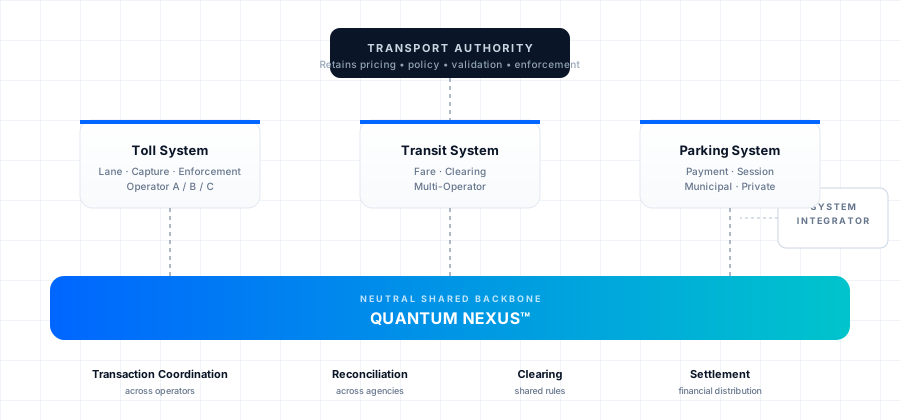
V01 · Quantum Nexus Backbone Diagram
Nexus as a horizontal shared layer connecting toll, transit, and parking systems. Authority above; SI alongside; Nexus neutral underneath.
Built for Tolling and RUC First
The architecture is tolling-first by design. Quantum Flux™ is the primary commercial entry point in developed markets, and the entire system is optimized for the properties tolling modernization programs require. Multi-domain expansion is enabled by the same backbone, but it is not the lead story.
Immediate Focus: Tolling & RUC
Quantum Flux™ is the system of record for tolling and RUC back-office operations. Deployment paths are optimized for SI-led, operator-led, and authority-led modernization programs that start with tolling.
Expansion Path: Same Backbone, New Domains
Transit (Metro), parking (Park), EV charging, and fleet services can be added on the same Nexus backbone over time—without re-platforming.
Governance-First Architecture
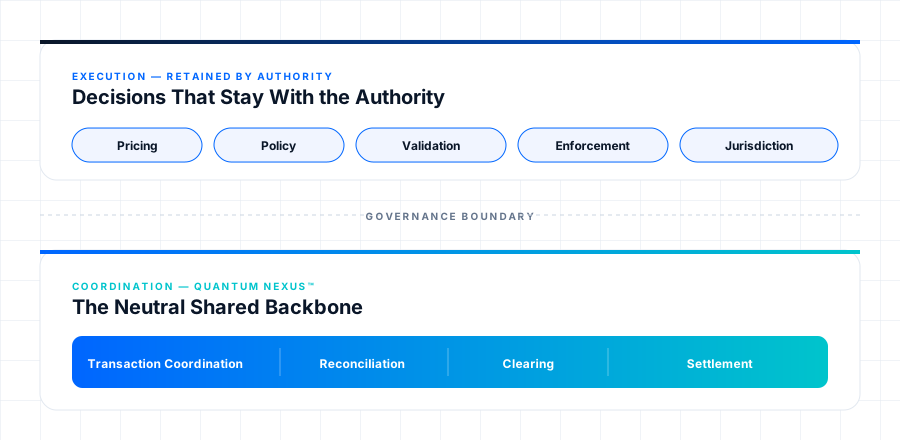
The system is designed around a clean split between execution and coordination. Authorities retain control over the decisions that must remain with them. Quantum Nexus™ coordinates transactions, reconciliation, clearing, and settlement across the systems that surround them.
Execution — Authorities Retain Control
Pricing and tariff-setting
Policy rules and exemptions
Validation and enforcement decisions
Program and jurisdictional boundaries
Revenue custody inside their jurisdiction
Coordination — Quantum Nexus™
Transaction coordination
Reconciliation across operators
Clearing across agencies
Settlement and financial distribution
Cross-system orchestration
Interoperability without centralization of control.
V02 · Governance-First Architecture Diagram
Execution (authority-controlled) and Coordination (Nexus-managed) shown as distinct layers with a clean boundary between them.
AI-Enabled Intelligence
AI is an embedded supporting capability in the architecture—not the core architecture and not the lead story. It is delivered through Quantum Atlas™ as reporting, anomaly detection, forecasting, and decision support built on real transaction and settlement data flowing through the Nexus backbone.
Built on real transaction, reconciliation, and settlement data
Explainable outputs that can be traced to underlying events
Auditable by regulators, finance teams, and SI program leads
Decision support, not automated decision-making
Never a replacement for deterministic system processing
Never a replacement for authority control
Embedded into the same backbone that handles transactions
Scoped to reporting, anomaly detection, forecasting, operational insight
AI is an embedded capability—not the product story.
Financial Integrity Through Architecture
The properties that matter to operators, authorities, and finance teams are structural—not retrofitted. They are outcomes of the Nexus backbone itself, enhanced where useful by AI-supported insights.
Reconciliation Consistency
Shared rules and lineage across operators replace bilateral custom reconciliation builds.
Settlement Predictability
Cycle visibility and clearing behavior that finance and audit teams can rely on.
Cross-Agency Auditability
A consistent audit trail across operators and authorities, not just inside one vendor environment.
Transaction-to-Settlement Lineage
End-to-end traceability from capture through settlement, accessible to the parties that need it.
AI-Enhanced Exceptions
Anomaly detection and exception prioritization support operational teams through Quantum Atlas™.
Forecasting Support
Settlement cycle and exception volume forecasting for capacity and financial planning.
Financial integrity is driven by architecture.
Designed for Real Delivery Models
The architecture is designed to drop into live programs—not to demand a structural replacement. It integrates with existing tolling back-office, lane, enforcement, and payment systems; respects established operator responsibilities; and reduces the amount of custom reconciliation and settlement code an SI has to build.
No Rip-and-Replace
Connects to existing systems. Existing field and capture systems continue to operate within their own boundaries.
Defined Boundaries
Clear responsibility boundaries between existing systems and the Nexus backbone. No scope conflict.
Phased Adoption
Modernization can proceed in phases inside a live program. Structural replacement is not required.
Multi-Agency Coordination
Designed for environments with multiple operators, agencies, and jurisdictions—with no assumption of a single central owner.
Deployment Models
SI-Led Modernization
Integrated within existing program architectures. Supports toll back-office modernization. Reduces custom reconciliation and settlement complexity. Primary in the US.
Toll-to-RUC Evolution
Extends existing toll environments into RUC. Preserves delivery continuity. Avoids structural replacement. Operator- or authority-led.
Controlled Expansion Beyond Tolling
Adds transit and parking later. Reuses the same backbone. Preserves operational continuity.
Full-Stack Mobility Deployment
Single platform across tolling, transit, parking, EV, and fleets. Unified transaction, reconciliation, and settlement layer. National or city-scale deployment in emerging markets.
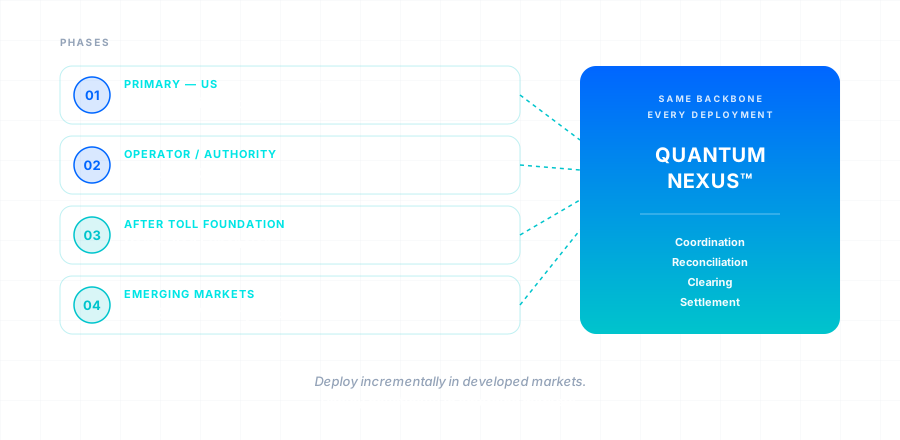
Deploy incrementally in developed markets. Deploy holistically in emerging markets.
V13 · Technology Deployment Paths
Four deployment models shown as parallel tracks converging on the same Nexus backbone.
Technology Principles
Neutral shared backbone—no central control tower
Governance-first: coordination without centralization
Deterministic transaction processing with immutable lineage
AI as an embedded supporting capability, never the lead architecture
Integration over replacement; phased adoption over rip-and-replace
Shared audit lineage across operators and agencies
Multi-domain extensible on the same backbone
A System That Coordinates—Without Compromising Control
Quantum Mobility provides a tolling and RUC back-office system, differentiated by a neutral shared backbone that enables coordinated reconciliation, settlement, and interoperability across operators—without compromising authority control, financial accountability, or delivery realism.